The Equilibar® Flow Control Valve

Equilibar® Flow Control Valve

The Equilibar® control valve is a precision back pressure regulator configured to control flow in a control loop with an electronic controller and a flow meter. 

Over a broad range of flow rates, Equilibar® control valves enable accurate flow control for gases, liquids, and mixed-phase fluids. The unique dome-loaded multiple orifice design adapts swiftly to changes in upstream and downstream process disturbances to maintain the setpoint.

The Equilibar® control valve functions differently than typical regulators and valves. The control valves are dome-loaded, and pilot operated, which means that gas is supplied to the dome (top) of the valve via a pilot controller to set the process setpoint. In the dome, a direct sealing diaphragm covers a field of orifices and adjusts its position allowing flow through the orifices while maintaining the desired setpoint. 

Equilbar Control Valve Loop

The Equilibar® flow control valve links to an electronic pilot pressure controller and a flow meter in a control loop. (See Fig.A.) To control flow, a proportional-integral-derivative (PID) controller monitors input from a flow transmitter (FT) and adjusts the pilot pressure. The electronic signal from the PID converts into a pressure signal for the pilot controller by an electro-pneumatic transducer (E/P). Increasing the pilot pressure reduces flow, and decreasing the pilot pressure increases flow. The system performs best when the supply pressure is stable.

Equilibar® valves may be an ideal closed-loop flow control option under challenging situations where typical flow control techniques fail. Equilibar® valves increase performance in a wide range of demanding applications such as:
  • Flow coefficient (Cv) ranges wider than conventional valves (>100:1)
  • Extremely low DP and extremely high DP
  • Two-phase, phase-change, and supercritical states
  • Continuous flow chemistry
  • Sanitary applications
For more information about Equilibar® products in Utah, Western Wyoming, Idaho, Northern Nevada, Arizona, New Mexico, Colorado, Eastern Wyoming, and Montana, contact Process Technology, Inc.

Process Technology, Inc.
801-264-1114


Tutorial for Setting the Siemens SITRANS P320/P420 for Level Measurement Applications


When used to determine fluid levels, pressure transmitters work on the following principle: the pressure at the bottom of a liquid body is proportionate to the height of the fluid above it. The transmitter measures the hydrostatic head pressure to get the fluid level measurement.

SIEMENS SITRANS P320/P420 pressure transmitters are digital pressure transmitters known for user-friendliness. SITRANS P hydrostatic level technology is suitable for use in harsh environments in the environmental, chemical, and petrochemical sectors. SITRANS P pressure/differential pressure transmitters are highly resistant to chemical and mechanical stresses and common electromagnetic interference. 

SITRANS P320/420 is the first pressure transmitter with remote safety handling. The remote safety management of the instruments through SIMATIC PDM saves time during SIL commissioning since operators may access transmitters from the control room rather than physically configuring each device across a facility. In situations needing functional safety, this decreases commissioning time. Both pressure transmitters feature a longer proof test interval than comparable devices on the market, with testing periods lasting up to fifteen years instead of every two, drastically reducing maintenance expenses.

Process Technology, Inc.
801-264-1114

Control Performance Analytics - CPA

Control Performance Analytics - CPA

Control Performance Analytics - CPA


As the complexity of industrial process applications grows, so do production management requirements for process safety, adaptability, and product quality. More openness is required to recognize the possibility for process improvement and fine-tuning.

Control performance is critical in process industries for meeting production objectives. Each process application begins with a single control loop. According to studies, around 50% of all control loops are not well-tuned, whether owing to non-optimal settings, manual operation, oscillating controlled systems, or mechanical faults with control valves.

Furthermore, process engineers are generally in charge of hundreds of control loops in large-scale process facilities. Evaluating control performance across several process stages for alarms takes a significant amount of effort and knowledge. Due to continuous process changes and equipment wear and tear, detecting potential areas for improvement and modifying control loops is not a one-time activity.

Automated Control Loop Analysis for Efficient Plant Optimization


CPA is a cloud-based managed service that improves the transparency of process data and the optimization of control loops. The collection and analysis of plant-wide data provide the client with comprehensive product control. Automatic KPI (key performance indicators) computation identifies control loop states, which can recognize setpoint tracking, steady-state difficulties, and even static or sliding friction in-process valves. The tool also enables automated testing of new parameter sets to test control loops without interfering with plant operations.

CPA - What Is It?


CPA takes data from SIMATIC PCS 7 or any other process control system, for example, in CSV format, and sends it to Siemens' cloud-based IoT operating system, such as MindSphere, through a secure connection. CPA creates reports and recommendations for the customer's support teams or Siemens' process consulting specialists to analyze based on the data. Finally, optimization ideas help to enhance the process.

Benefits of Control Loop Optimization Through CPA

  • Increased product quality due to lower fluctuation in process variables
  • Maximized equipment lifetime due to reduced variability in actors
  • Improved set points raise throughput by going closer to the limits
  • Resource savings thanks to improved set point tracking behavior (e.g., energy, raw material)
  • Reduced manual mode of control loops allows overlaying control optimizations such as Advanced Process Control
  • Fewer alarms and fewer operator interactions reduce operators‘ workload

Siemens CPA User Advantages

  • PLANT-WIDE TRANSPARENCY
    • Includes hierarchical plant overview, from management view to single control details for Siemens SIMATIC PCS 7 and other DCS.
  • IMPROVED PLANT ASSET PERFORMANCE
    • Identification of optimization potential as a result of correlating process data automatically with possible asset problems.
  • FAST SETUP
    • Intuitive interface enabling customer to use the application without extensive training.
  • AUTOMATIC STATE DETECTION AND KPI CALCULATIONS
    • Messaging behavior, service factor, steady state accuracy, set point tracking and static friction probability for various control states.
  • COST BENEFITS
    • Long-term process optimization and flexible managed service approach – pay only when you use the application.
  • OPEN, CLOUD-BASED IOT OPERATING SYSTEM
    • CPA is part of Siemen's Asset and Process Performance Suite for industrial applications and advanced analytics.
Contact Process Technology for all your Siemens Process Control products. Call them at 801-264-1114 or visit them at https://process-tech.com.

Compact Portable Samplers: The Foundation for Your COVID-19 Wastewater Surveillance Program

COVID-19 Wastewater Surveillance

An effective COVID wastewater monitoring program relies on representative samples. 


Water samplers are critical components in developing and deploying a community-based underground sewage surveillance program for COVID-19 outbreak detection, including best practices for wastewater sampling, lab analysis, and the immediate delivery of actionable information to local public health officials and administrators.


Wastewater testing refers to numerous water quality procedures examining wastewater's physical, chemical, and biological qualities. 


Officials in certain areas are analyzing wastewater to see whether it contains Covid-19. The test looks for ribonucleic acid (RNA), Covid-19's genetic material, in feces found in sewage and wastewater. 


SARS-CoV-2 causes Covid-19. According to studies, people with SARS-CoV-2 start spilling the virus in their feces shortly after infection. The virus's DNA enters the huge wastewater collecting network. The viral content of a community's wastewater may reflect the prevalence of Covid-19. Modern sampling and analysis methods can identify and quantify it up to a week before people test positive in clinics. Individual testing, contract tracking, and quarantine are possible mitigation and reaction methods. It also enables population sampling and monitoring of large-scale public health initiatives. 


Analysis of viral concentrations in particular institutions such as nursing homes and college dormitories and neighborhoods or whole communities may help restrict the spread and avert additional harm. 


The CDC created the NWSS in September 2020 in response to the COVID-19 pandemic. The CDC's National Watershed Surveillance System (NWSS) coordinates and increases the nation's ability to monitor SARS-CoV-2. 


There may be a way to identify the new Coronavirus in low quantities in wastewater. Many states, including Colorado, Ohio, New York, and Wyoming, have successful Covid-19 wastewater testing programs. Universities and municipalities use this method to identify community hotspots. Multiple success stories have proven early identification and control using dorm wastewater monitoring and individual COVID testing. These universities were among the first to use COVID patterns in wastewater to reduce community spread inside dormitories and across campus. 


Representative samples facilitate COVID wastewater monitoring. For COVID-19 epidemic identification, water samplers are essential for wastewater collection, lab analysis, and quick distribution of actionable information to local public health authorities and administrators. These data disclose the population numbers in a specific geographic region to estimate the virus's prevalence and quantity in wastewater. Combine Hach® small portable samplers with laboratory testing for automated composite wastewater sample collection that may help avoid outbreaks.


VISIT THIS PAGE ON THE PTI WEBSITE FOR MORE INFORMATION ON THIS SUBJECT.


Process Technology, Inc.
801-264-1114

A Superior Method of Measuring Dissolved Oxygen in Pure Water Systems at Power Plants

Measuring Dissolved Oxygen in Pure Water Systems at Power Plants

Approximately half of all unexpected shutdowns in power plants happen because of water cycle chemistry difficulties, which result in expensive repairs and unrecoverable lowered operating income. Dissolved oxygen, or DO, is one of the most critical metrics to monitor to increase the efficiency of power plant water systems. DO induces corrosion in iron and copper-containing components. These particles' transport and deposits may potentially hasten deterioration and destroy vital industrial equipment. 

DO is monitored at numerous points across a water system. DO is traditionally detected using polarographic sensors, which employ a gas permeable membrane to separate the sample from the electrochemical cell within. Polarographic sensors may need monthly electrolyte and membrane changes depending on the working conditions. Because of the required polarization, the sensor cannot generate valuable results for many hours after service. They are also affected by dissolved hydrogen and are sensitive to sample flow rate. 

The Mettler Toledo Thornton online pure water optical DO sensor, unlike typical DO sensors, does not need polarization. It analyzes data quickly and accurately by using optical technologies. It responds to measurements six times quicker than polarographic sensors. Because the optical DO sensor does not require an electrolyte or a membrane, it is not sensitive to flow and is not vulnerable to particle and dissolved hydrogen interference. There is no internal body to repair, and servicing is only necessary once a year to quickly change the one-piece Optocap sensing element, decreasing operating costs and downtime for facilities. 

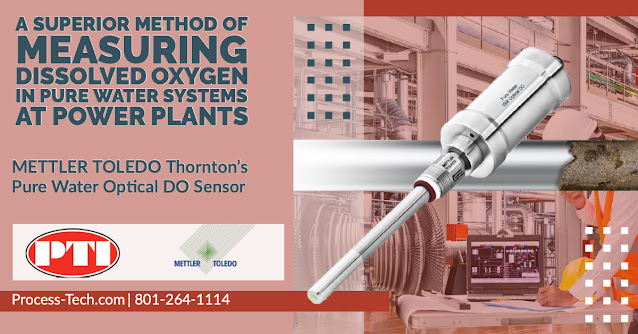
The Mettler Toledo Thornton pure water optical DO sensor measures dissolved oxygen content in power plant pure water systems quickly, accurately, and with low maintenance.

Process Technology, Inc.
801-264-1114

PTI Salespeople Dan Taylor & Daniel Gibbs at Siemens Process Automation Training


Process Technology, Inc. salespeople Dan Taylor & Daniel Gibbs at Siemens Process Automation training explain PTI vertical markets and territory in this video.

Process Technology, Inc.
801-264-1114