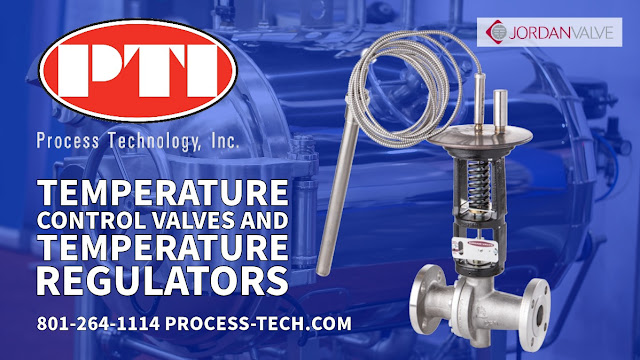
Temperature control valves and temperature regulators, often known as TCVs, actively maintain the temperature of a process. They achieve this by regulating the pressure or flow of thermal fluid in various components such as compressors, tank jackets, and heating coils. These devices are essential in processes requiring stable temperatures unaffected by fluctuations in the surrounding environment.
Temperature regulators fall into two main categories: self-actuated and externally actuated. Self-actuated temperature regulators operate independently without the need for an external power source. They use a thermally sensitive material that expands and contracts in response to temperature changes. This expansion and contraction drive the actuator, adjusting the valve's position and altering the flow path of the thermal fluid toward the heating element. This mechanical actuation provides precise temperature control, particularly suitable for applications where the setpoint remains constant and does not require frequent adjustments. Additionally, self-actuated temperature regulators offer a cost-effective solution for effective temperature management. These regulators are also known as self-operated temperature regulators.
Externally actuated temperature control valves often play a critical role in complex control systems, integrating an external temperature sensor and a Proportional-Integral-Derivative (PID) controller. These valves necessitate an external power source for operation. In a typical setup, the operator sets a desired temperature on the PID controller, continuously receiving feedback from the temperature sensor monitoring the process. The PID controller then compares the set temperature with the actual process temperature reported by the sensor. Based on this comparison, it sends an electronic or pneumatic signal to the temperature control valve, instructing it to adjust its position. This adjustment ensures the maintenance of the process temperature at the set point. This type of valve is beneficial in applications requiring frequent adjustments of temperature set points for automation purposes.
How Does the Jordan Valve Mark 80 Series Temperature Regulator Function?
The Jordan Valve Mark 80 Series Temperature Regulator operates independently, eliminating the need for an external power source or costly additional instruments. This self-sufficiency is due to its unique design: the actuator connects to a sensing bulb via a capillary system containing a volatile fluid. When this fluid heats up, it vaporizes, creating pressure within the system. This pressure acts on the diaphragm, prompting the valve to open (in reverse-acting models) or close (in direct-acting models). The Mark 80 Series, featuring a seal welded actuator (SWA), results from extensive research, ensuring the most accurate temperature control. When paired with Jordan Valve's sliding gate valve technology, the Mark 80 regulator achieves superior control. For added versatility, it allows field adjustments of the set point and can accommodate different temperature ranges without removing the valve from its installation.
The Jordan Valve Temperature Regulator Series also presents various self-operated regulator configurations to cater to higher flows, fail-open or fail-close settings, tracing lines, and pilot operations.
Process Technology, Inc.https://process-tech.com
801-264-1114
