Showing posts with label Tideflex. Show all posts

How the Tideflex Mixing System Keeps Potable Water Tanks Clean and Compliant

How the Tideflex Mixing System Keeps Potable Water Tanks Clean and Compliant

The Tideflex Mixing System (TMS) by Red Valve offers a simple yet highly effective solution for improving water quality in potable water storage tanks. Unlike mechanical mixers that require electricity and regular maintenance, the TMS uses the natural energy of a tank’s fill and draw cycles to keep water thoroughly mixed, making it a passive system that requires virtually no upkeep.

Thousands of installations—from small 2,000-gallon tanks to massive 20-million-gallon reservoirs—prove how well this system works across all types of tanks, including standpipes, elevated tanks, and irregularly shaped reservoirs. Water utilities and engineers trust the TMS because it addresses common problems like thermal stratification, dead zones, and short-circuiting that often occur in storage tanks.

Here’s how it works: The TMS design includes Tideflex® inlet nozzles and Waterflex® outlet valves that create strong, controlled flow paths inside the tank. These nozzles and valves are NSF 61 certified for drinking water safety. Separating the inlet and outlet through a single manifold pipe ensures that fresh water moves throughout the entire tank, not just part of it. This movement blends water completely, preventing pockets of stagnation and maintaining consistent water quality.

Tideflex engineers customize each system using computational fluid dynamics (CFD) and scale models. They also perform a Mixing Analysis to determine, based on real-world usage, how much tank turnover is needed to achieve complete mixing. For existing tanks, they can reverse engineer the system to match how the tank is currently operated, ensuring performance even in retrofits.

This level of engineering attention matters because improper mixing can lead to serious water quality issues. The TMS helps prevent the formation of disinfection byproducts (DBPs), reduces the risk of nitrification in chloraminated systems, maintains disinfectant residuals, stabilizes pH and dissolved oxygen levels, and even reduces the chance of ice formation in cold climates.

The need for reliable water quality management grows as regulations like the Stage 2 Disinfectants and Disinfection Byproduct Rule evolve. The Tideflex Mixing System meets this need without adding complexity or long-term maintenance costs. And because it’s been validated through modeling and utility operators sampling real-world water parameters—such as temperature, residual chlorine, pH, and bacterial counts—its effectiveness is more than just theoretical.

Whether in a new tank or an aging one already in service, the TMS installs easily and lasts for decades. The Tideflex Mixing System delivers a straightforward, proven answer in a world where consistent water quality is non-negotiable.

https://process-tech.com
801-264-1114

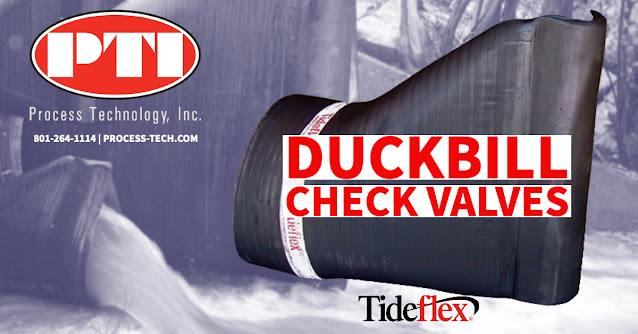
Duckbill Check Valves

Duckbill Check Valves

Duckbill check valves allow flow in only one direction through a pipe or tube while preventing any backflow in the opposite direction. When fluid pressure is applied from the upstream side, the duckbill flexes open to allow flow. But if pressure comes from the downstream side, the duckbill flaps seal shut to block reverse flow.


Typical applications for duckbill check valves include:


  • Preventing sewer and septic tank backflow
  • Inline pump protection
  • Sprinkler and irrigation systems
  • Drainage and flood control


Duckbill valves' simple, passive operation offers reliable backflow prevention without needing manual intervention, a power source, or maintenance. The elastomeric duckbill is the only moving part. Its flexing action allows it to seal around solids, making it resistant to clogging compared to other check valve designs with hinge mechanisms that can jam.


Duckbill valves find wide use across industrial, municipal, and commercial sectors due to their simple and reliable operation, compact size, and low cost compared to mechanical check valves. Some of the most common applications include:


  • Wastewater and stormwater management: Duckbill valves are extensively used in sewer lines, septic systems, and stormwater outfalls to prevent backflow of contaminated water during heavy rains or floods. They are less prone to clogging than flap valves.
  • Irrigation and agriculture: In sprinkler systems and agricultural pipelines, duckbill valves maintain consistent flow direction and prevent pump prime loss. They also inhibit dirt, rodents, or other foreign materials from entering pipes.
  • Marine and aquatic systems: Duckbill valves are used in boat bilge pump discharge lines, live fish holding tanks, and pond aeration systems. Their unobtrusive profile minimizes flow restrictions.
  • Industrial processes: In chemical processing, printing, and manufacturing operations, duckbill valves control gases and liquids, vent tanks and pipelines, and isolate pressure gauges and instruments.

Compared to traditional swing check valves or spring-loaded poppet valves, duckbill valves offer several advantages:


  1. No mechanical hinge or spring to fail or wear out, giving them superior reliability and service life.
  2. Low cracking pressure and high flow rate due to streamlined design.
  3. Tight sealing even around suspended solids and minimal leakage.
  4. A simple one-piece elastomer duckbill is inexpensive to manufacture and easy to replace.
  5. Various elastomer choices to suit corrosive chemicals, high temperatures, or food grade needs.


Duckbill check valves' versatility, dependability, and low maintenance requirements make them a popular choice across diverse industries for providing economical, trouble-free backflow prevention and fluid control. While not suited for every application, they offer an elegant solution in many common fluid handling scenarios. 


Process Technology, Inc.
https://process-tech.com
801-264-1114

Duckbill Check Valves: Ensuring One-Way Fluid Flow in Water Treatment, Mining and Industrial Systems

Duckbill Check Valves: Ensuring One-Way Fluid Flow in Industrial Systems

Duckbill check valves, also known as rubber check valves or elastomer check valves, allow fluid to flow in one direction but close to prevent backflow when the fluid direction reverses. The bill of a duck inspires their design, hence the name "duckbill."

Construction:

Duckbill check valves are constructed mainly from flexible materials like rubber or elastomers. The valve's shape resembles a duck's bill or a pipe tapering into a flattened or cylindrical end. This end is split into two halves lengthwise, forming the "lips" of the duckbill.

When pressurized from one side (the inlet side), the lips of the duckbill valve open to allow the fluid to flow through. When the pressure on the outlet side is higher or the flow ceases, the lips close to prevent backflow. The closing mechanism relies on the material's elasticity, which brings the lips back together when there's no differential pressure.

The simplicity of this design means there are no mechanical parts to maintain or fail over time, which contributes to the valve's durability and long lifespan.

Application:

Duckbill check valves have a wide range of applications, including:
  • Water and Wastewater Treatment: Duckbill valves are commonly used in water and wastewater treatment plants to prevent backflow, which ensures that treated water doesn't mix with untreated water.
  • Sewage Systems: They can be used in sewer systems to prevent the escape of unpleasant odors and stop pests from entering the system.
  • Stormwater and Flood Control: Stormwater drainage systems can prevent floodwaters from flowing back into the drainage system.
  • Industrial Process Lines: In various industrial processes where backflow must be prevented.
  • Mining: In mining operations, duckbill check valves are used to control the flow of materials.

In short, the duckbill check valve is a simple, robust, and effective solution for managing fluid flow in a system, particularly in applications where backflow prevention is essential.

Process Technology, Inc.
801-264-1114

The Tideflex TF-1 Check Valve

The TF-1 is the most popular Tideflex Check Valve configuration for outfalls. The TF-1 has a flat bottom and a flared top designed for in-structure and end-of-pipe installations. As a result, the valve can be installed at a lower overall elevation than in other configurations, requiring less bottom clearance.

The TF-1 is ideal for maintenance hole applications such as junction boxes, diversion chambers, and interceptors where the pipe invert is close to the vault floor. The invert pipe is as close to the floor as possible in these vaults to maximize the available gravity head. The TF-1 is designed to install within such structures and can be easily retrofitted to existing systems, frequently replacing failed flapgates. 

For more information contact Process Technology, Inc.
801-264-1114
https://process-tech.com

The Tideflex Technologies CheckMate® UltraFlex™ Inline Check Valve


The Tideflex Technologies CheckMate® UltraFlex™ Inline Check Valve is the valve of choice for municipal applications such as stormwater, wastewater, highway run-off, CSO, SSO and flood control. It is the most user friendly inline check valve on the market today. From the upstream or downstream end of the pipe, simply insert the valve into position and clamp it into place. Typically no modification to the pipe or structure is required.  CheckMate® UltraFlex™ Valves have become the specified solution for residential and commercial areas where complete, dependable backflow prevention is necessary to prevent surcharging and flooding.

For more information, contact Process Technology, Inc. Call them at 801-264-1114  or visit their web site at https://process-tech.com.